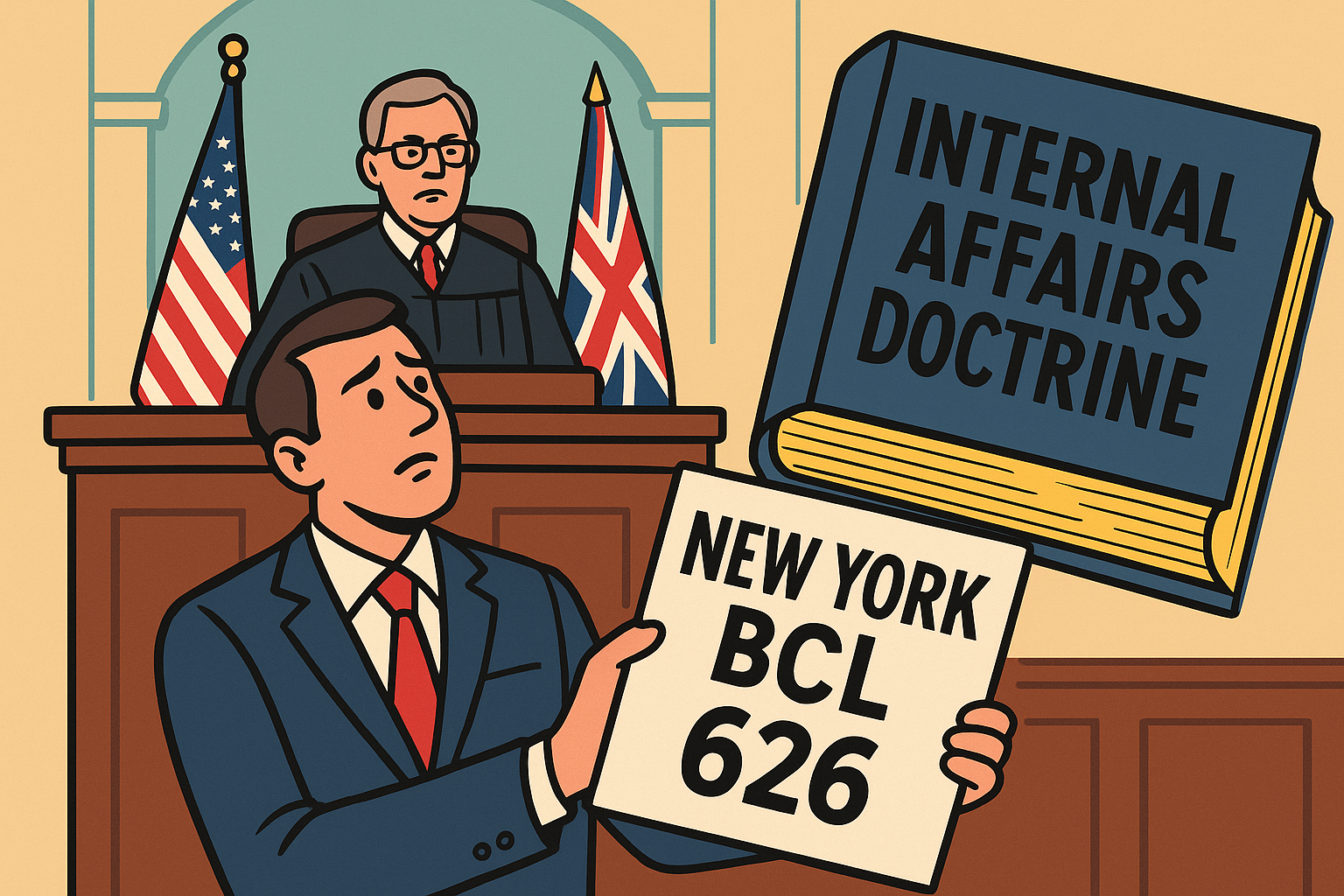
What must a shareholder show to maintain a derivative action on behalf of a foreign corporation doing business in New York? This week’s post unpacks the Court of Appeals’ emphatic reaffirmation of the internal affairs doctrine.

What must a shareholder show to maintain a derivative action on behalf of a foreign corporation doing business in New York? This week’s post unpacks the Court of Appeals’ emphatic reaffirmation of the internal affairs doctrine.
This week’s post features Part 2 of Peter Mahler’s video interview on a variety of business divorce topics.
Continue Reading On Camera: My Recent Video Interview on, What Else, Business Divorce (Part 2)

This week’s post unpacks a novel estoppel defense that put the brakes on the manager’s right to make a mandatory capital call.
Continue Reading Capital Call Cancelled: A Fairness Defense to the Majority’s Mandatory Capital Call
This week’s post features Part One of a two-part video interview of Peter Mahler on the subject of business divorce.
Continue Reading On Camera: My Recent Video Interview on, What Else, Business Divorce (Part One)

Section 417 of New York’s LLC Law permits the members to eliminate their fiduciary duties, but only in very narrow circumstances. This week’s post shows how the seemingly toothless provision can carry the day.
Continue Reading The Humble LLC Exculpation Clause Wins Big: Member/CEO Escapes $8M Fiduciary Claims

A court order directing a party to file a verified formal accounting is not to be taken lightly, and certainly not to be contradicted by the accounting party, as the unfortunate defendant found out in a post-trial decision issued earlier this month by Commercial Division Justice Jennifer Schecter.

Pre-answer motions to dismiss for untimeliness are exceptionally common in business divorce litigation. Statute of limitations analysis can be deceptively simple in theory, but elusively difficult in practice, even for veteran judges. Identifying the applicable statute of limitations is just one of three steps a court must perform as part of its decision making process:
A recent decision from the Albany-based Appellate Division – Third Department, Lambos v Karabinis (___ AD3d ___, 2025 NY Slip Op 03367 [3d Dept June 5, 2025]), is a reminder to business divorce litigants – on either side of the v. – not to overlook that crucial third step in the statute of limitations analysis, which can rescue complaints from pre-answer dismissal even if they allege misconduct from decades earlier.Continue Reading A Tardy Plaintiff’s Best Friend: The Open Repudiation Doctrine

Two recent cases, one from the Second Department and one from Suffolk County Justice Garguilo, shed light on some of the more nuanced issues in shareholder oppression litigation: the “equitable” prejudgment interest rate to be applied to a buyout under BCL 1118, and the relationship between a claim for dissolution and one for money damages.
Continue Reading Beyond Fair Value: When Shareholder Oppression Demands Interest and Damages

Did a 25% shareholder forfeit her equity in an entertainment industry management company when she announced her intention to retire? Learn the answer in this week’s New York Business Divorce.
Continue Reading Retirement of Working Owners of Closely Held Business Entities: What’s Your Plan?

This week’s New York Business Divorce takes us to the Garden State for a delightfully-written, post-trial decision by retired, recalled Appellate Division Judge Clarkson S. Fisher, Jr.
Cheshun v Sikand, Opinion [NJ Super Ct, Monmouth County May 7, 2025]), was a dissolution proceeding under New Jersey’s version of the Revised Uniform Limited Liability Company Law (“RULLCA”) between two 50/50 LLC member-managers who founded and operated an entity they hoped would perform clinical drug trials, but which never really got off the ground.
A couple of lessons emerge from Cheshun.
First, it seems obligatory for close entity owners and their litigation counsel to throw stones, cast aspersions, and lay blame for the business’s demise. But like marriages, sometimes business relationships fail because of good faith disagreements and reasonable, dashed expectations. Sometimes nobody is to blame. And that is ok.
Second, business owners may agree to part ways, but the decision to do so does not sever the existence of one’s ongoing fiduciary duties. Fiduciary duties continue through the conclusion of the wind up process. In the words of Judge Fisher, where a business entity is in a “state of un-woundedness,” failure to heed one’s fiduciary duties – even after an agreement to separate – can prove costly.Continue Reading A Message of Acceptance from the Garden State